
askOdin Crucible · Free Pitch Deck Audit
Investors audit logic, not slides.
Find the structural flaws before the partner meeting.
A structural flaw found by an investor costs you that investor. The same flaw found beforehand costs you an afternoon. They rarely tell you which one it was.
askOdin Crucible runs the same forensic pass an investment committee runs. It compiles the claims in your deck, checks them against your own numbers, and names the structural problems by location. Free, and it takes under three minutes.
Not to improve your storytelling. To find what breaks.
PDF deck required · financial model optional — it unlocks the Verified Brief
Sample output. Run yours →
THE DILIGENCE DATASET
Founders describe the problem well. Two in three describe the business badly.
We scored 2,488 decks on one engine version inside a single four-week window, so the numbers are comparable to each other. The median deck came out at 35 out of 100. The interesting part is not the median — it is where the points went missing, and it is the same place almost every time.
- Problem Definition — is the pain structural, or cosmetic?17.9% below half · median 12 / 20
- Solution Logic — does the mechanism survive its own physics?0–20
- Market Evidence — is demand pulling, or are you pushing supply?0–20
- Business Model Physics — do the unit economics scale, or collapse under load?67.0% below half · median 6 / 20
- Deal Structure — the ask and milestones. Is the raise sized to what it has to prove?0–20
A 3.7× spread between the strongest section of a deck and the weakest, measured across the same documents. Investment committees rarely pass because a founder cannot say what is broken in the world. They pass because nobody cross-examined how the money is supposed to work.
Five pillars, twenty points each. Three audit checks — business physics, unit economics, market evidence — that can cap any pillar regardless of what it scored on its own. Design, wording and delivery are worth nothing.
Most founders optimize their pitch.
Institutional investors optimize their reasoning.
Those are not the same thing.
A compelling presentation can still hide structural weaknesses. An elegant narrative can still depend on fragile assumptions.
Investment committees are not evaluating slides. They are evaluating whether your reasoning justifies allocating capital.
Crucible evaluates the investment thesis behind the presentation — not simply the presentation itself.
WHAT THAT LOOKS LIKE — THE THERANOS DECK, SCORED 0
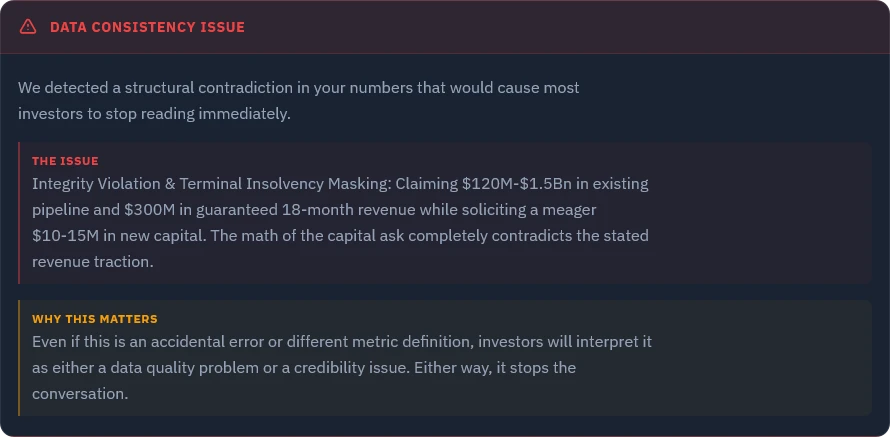
The slides were never the problem. The pipeline figure and the capital ask could not both be true — a contradiction in the numbers, not in the storytelling.
Every Investment Committee asks difficult questions.
The best founders ask them first.
Investment Committees rarely reject companies because founders cannot answer obvious questions. They reject opportunities because deeper questions expose assumptions that were never challenged.
- Market assumptions
- Competitive assumptions
- Execution assumptions
- Financial assumptions
- Risk assumptions
Crucible surfaces those questions before your investors do.
Because discovering weaknesses before diligence begins is dramatically less expensive than discovering them during committee review.
ONE ASSUMPTION, FROM A LIVE RUN ON THE AIRBNB DECK
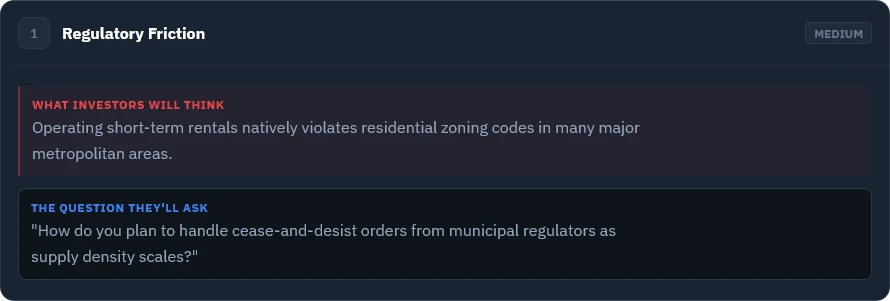
Not a score. The objection itself — and the sentence it becomes when someone says it out loud across the table.
THREE DECKS, ONE STANDARD
A score is only worth reading if it can say no.
The same engine, run against three decks. Nothing here is a mockup — you can reproduce all three from the demo links inside Crucible.

Theranos — hard pass
“A compelling paradigm shift completely undermined by catastrophic integrity flags. The capital ask mathematics fatally contradict the stated commercial traction.”

Airbnb — hidden alpha
“A textbook example of unlocking latent supply. The omission of the funding ask is a procedural flag, but the underlying business physics represent a clear paradigm shift.”

A deck that clears
“High intellectual honesty, clear unit economics, and an acute understanding of the structural flaw in current AI tools. The paradigm shift is valid.”
Learn before you pitch.
Every evaluation produces structured feedback explaining where your reasoning is strongest — and where it remains vulnerable.
Rather than receiving generic writing suggestions, founders gain insight into the assumptions, evidence, and logic most likely to be challenged during institutional diligence.
The goal is not a higher score. The goal is a stronger investment thesis.
STRUCTURED FEEDBACK, NOT A GRADE
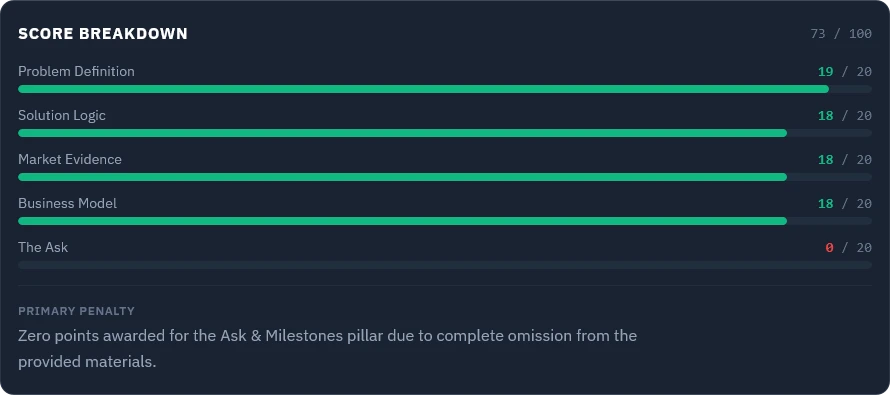
Four pillars near full marks and one at zero — because the deck never named its ask. Deal Structure shows as “The Ask” in the product. A fixable omission, and a twenty-point hole until it is fixed.
WHEN THE NUMBERS HOLD
The askOdin Verified Brief.
Upload the deck alone and we audit the narrative — what the deck claims about the business. Upload the financial model with it and we cross-check every claim against your own numbers. There is nothing to cross-check without the model, which is why the brief requires both.
If the math holds and the deck scores 85 or above, you earn a Verified Brief: a public link anchored to SHA-256 fingerprints of the exact files you submitted. An investor can check it without taking your word for it, or ours.
Then you can put the badge on your own site, and it points back at the brief.
WHAT CLEARING THE BAR LOOKS LIKE
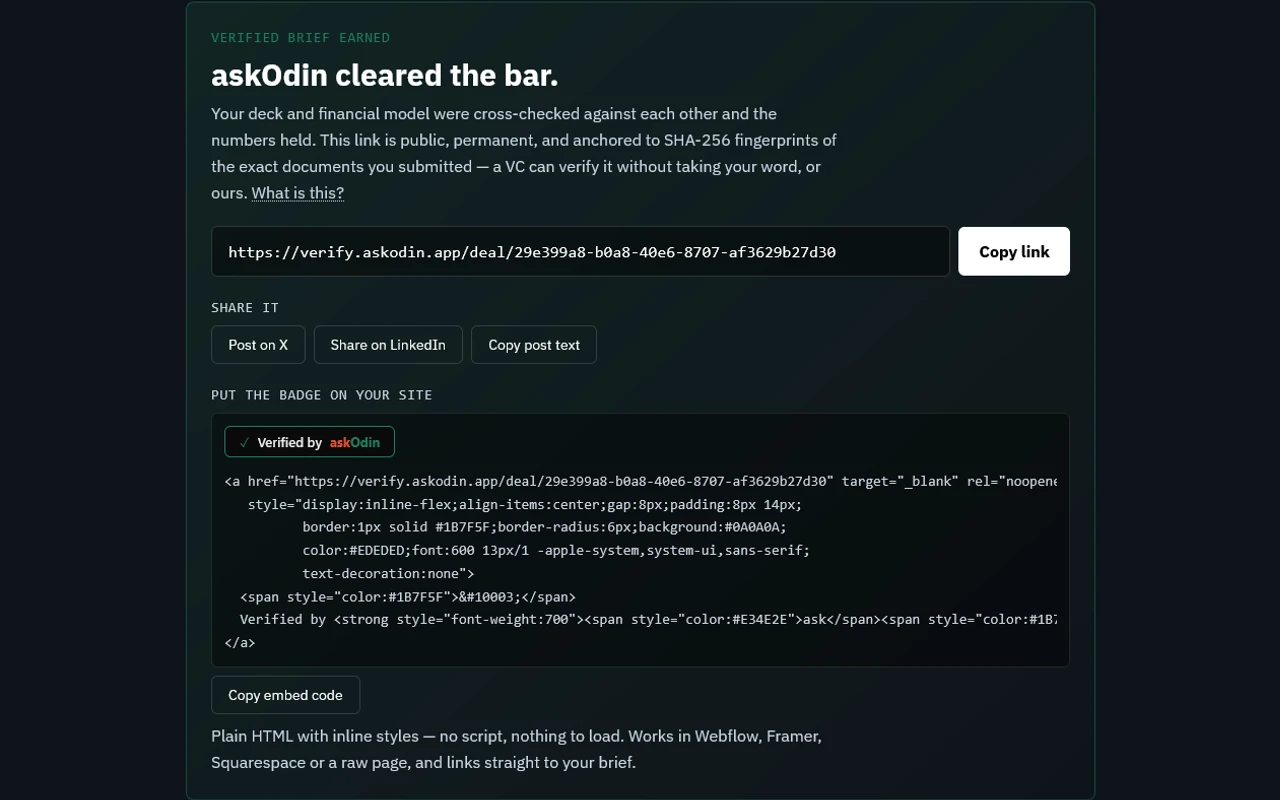
The embed is plain HTML with inline styles — no script, nothing to load. It works in Webflow, Framer, Squarespace or a raw page.
What the badge attests is narrow and worth stating plainly: the claims in your deck reconciled against the numbers in your model, on the date of the audit, for the documents fingerprinted in the brief. It is not a verdict on the business, an endorsement, or a substitute for diligence. We audit reasoning, not truth.
What happens to your deck.
You are being asked to upload confidential material to a company you have not met. Here is the whole answer, including the part that is still a policy rather than a control.
You retain full ownership. Your deck is sent to Google's Gemini API for extraction under a paid-tier agreement that prohibits training use; all scoring is done by our own deterministic engine. No customer document enters any training corpus. We never sell your deck or share it with investors.
Raw files are held no longer than 30 days under a documented retention ceiling. Automated enforcement of that ceiling is in progress and ships with SOC 2 Type I — until it does, deletion is a documented policy executed on request, and we would rather say so than call it a control.
THE SAME TERMS, ON THE UPLOAD SCREEN
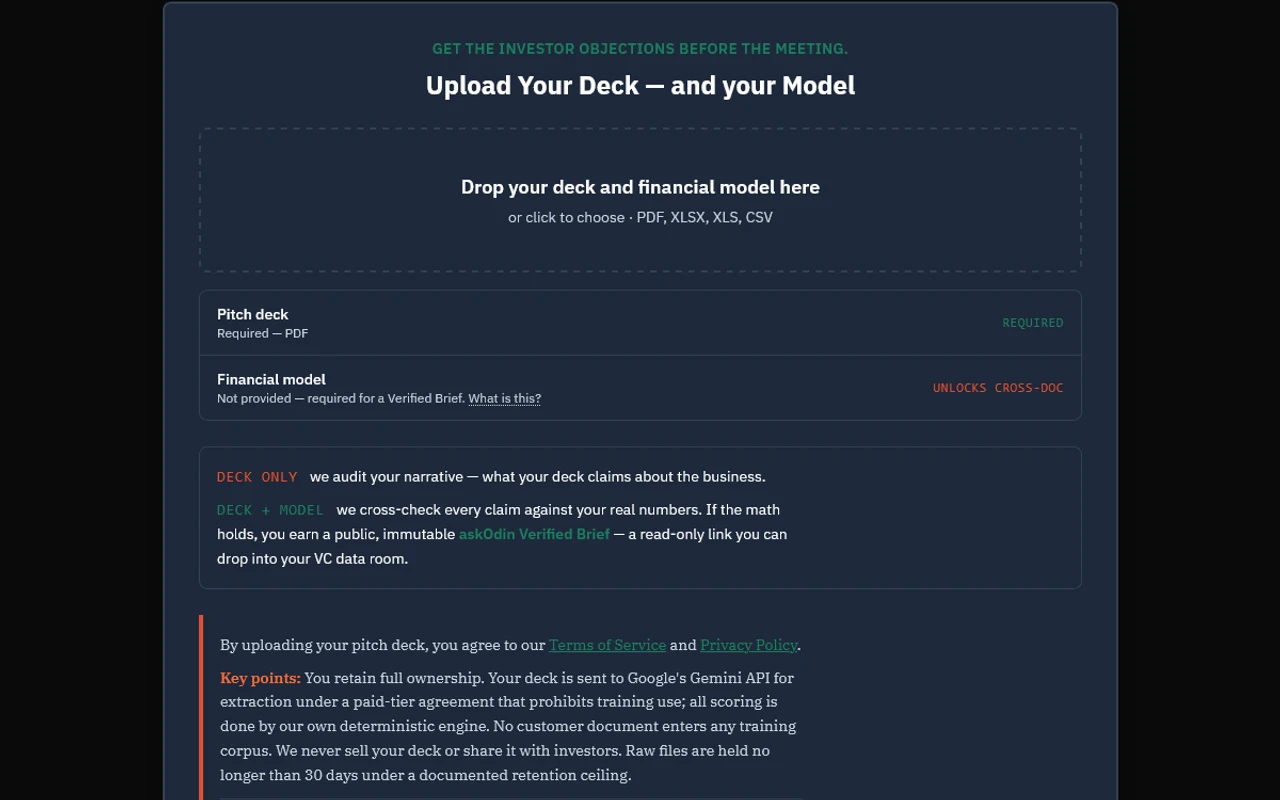
A policy that only appears in a trust page is a policy you have to go looking for. It is on the screen where the file is chosen, which is the only place it matters.
THE SAME STANDARD
Same standard, both sides of the table.
Investment firms run askOdin Clarity across a pipeline of deals. You are running the same engine, on the same Clarity Framework™, against one deck — yours. The score means the same thing in both. The standard does not change depending on who is holding it.
That is also the answer to why it is free. A deck that has already had its contradictions found is a better deal to underwrite, and we would rather see it that way round. Founders get the objection early; investors get a cleaner opportunity.
You are not being scored against other founders. You are being scored against the math.
What Crucible is not.
- It does not predict whether your company will succeed.
- It does not replace investors.
- It does not guarantee funding.
- It does not reward persuasive storytelling over disciplined reasoning.
It evaluates the quality of your investment thesis using the same institutional standard applied before capital is committed.
Investment outcomes remain uncertain. Investment reasoning should not.
// BEFORE YOU RUN IT
Founder questions
What Crucible is
What is Crucible?
Crucible is a free pitch deck audit — a forensic pass over the reasoning in your deck. It compiles the reasoning in your deck — the claims, the unit economics, the way the numbers relate to each other — and returns a Clarity Score out of 100 with the specific structural problems named and located. It is the same standard institutional investors apply, run before you pitch rather than after.
How is Crucible different from a pitch deck analyzer or a deck review service?
Most deck tools evaluate the presentation: layout, story arc, whether the narrative flows. Crucible evaluates whether the underlying business logic holds — whether the revenue model closes, whether the growth assumption survives its own maths, whether two slides contradict each other. Design feedback tells you how the deck reads. Crucible tells you what an investor will find when they check.
Can’t I just ask ChatGPT to review my pitch deck?
ChatGPT tells you whether your deck reads well — it optimizes for persuasion. The Crucible compiles whether the underlying physics hold, catching the structural kill shot a probabilistic model glosses over. That is the difference between flattery and diligence.
What is the difference between the Crucible and Clarity?
Same engine, opposite side of the table. The Crucible is free and built for founders auditing one deck — your own — before you pitch. Clarity is the institutional product investment firms run across a pipeline of deals, with the committee memo, provenance record and team workflow that context requires. The score means the same thing in both.
When to run it
When should I run Crucible — before or after I start pitching?
Before. A structural flaw found by an investor costs you that investor; the same flaw found beforehand costs you an afternoon. The expensive version of this feedback arrives as a pass you never get an explanation for. Run it while the deck is still yours to change.
Is the Crucible right for my stage?
It applies from pre-seed through Series B, but what it catches shifts. Early on, most findings are about coherence — whether your assumptions agree with each other. Later, they are about evidence — whether the numbers you claim are supported by what you can show. The one case where it adds little is a company with no deck and no model yet.
My numbers are still estimates. Is it too early to run this?
No — early is when it is most useful. Crucible does not require audited figures. It tests whether your assumptions are consistent with each other and with the story you are telling: whether the hiring plan matches the revenue ramp, whether the burn supports the runway you claim. Estimates can be coherent or incoherent, and that distinction is exactly what gets tested.
What I need to start
Is the Crucible really free, or is there a catch?
Fully free — no credit card, no trial expiry. Founder feedback is the free ingestion layer; the institutional Clarity tier is what funds pay for. You get a bulletproof deck; we get a smarter ecosystem.
Do I need to sign up or give an email to get a score?
No signup is required to run the Crucible. Compile your deck and read the verdict.
What do I upload, and how long does it take?
A PDF or PPTX deck — a financial model in XLSX is optional. A forensic pass takes minutes, before you ever walk into the room.
What file formats can I upload?
A deck as PDF or PPTX, and optionally a financial model as XLSX. If your deck lives in Google Slides, Figma, Canva or Notion, export it to PDF first — that export is what an investor receives anyway, so it is the honest thing to test.
Do I need a financial model, or is the deck enough?
The deck alone produces a score. Adding the model produces a better one, because it lets the engine check the deck's claims against the numbers underneath them — the most common place a contradiction hides. If you do not have a model yet, run the deck now and re-run once you do.
What happens to my deck
Do you keep my deck or train your models on it?
Your deck is processed to extract structural variables, never sold or shared, and never used to train a model. The file itself is held no longer than 30 days under our retention ceiling. The structural data derived from it persists and can include identifying details such as your name, so you can ask us to erase it. You retain full ownership of your IP.
Will you share my deck or my Clarity Score with investors?
No. Your submission and your score are private to you. We never sell, share, or surface your deck or score to any investor or third party.
Can I share my Crucible result with investors?
Yes. The result is yours and we never surface it to anyone. Founders use it two ways: privately, to find and fix problems before pitching, or deliberately — bringing a scored, sourced audit into a conversation as evidence the numbers have already been stress-tested. The second is unusual, which is exactly why it lands.
Does askOdin invest, or introduce me to investors?
No to both. We are infrastructure, not a fund and not a matchmaking service. We do not take equity, do not broker introductions, and do not pass your deck to anyone. A high score is not a referral — it is evidence your reasoning survives scrutiny, which is a thing you carry into your own conversations.
What the score means
What is a Clarity Score?
A Clarity Score is a 0–100 measure of how well the reasoning in a deck holds together. It comes from five scored pillars and three audit checks — problem, solution, business model, deal structure and the evidence behind them — not from design, wording, or how convincing the story sounds. The same score means the same thing for every deck, which is what makes it comparable.
What do the score bands mean?
The engine returns a verdict alongside the number. 85 and above is PRIORITY — high clarity, the logic holds. 70–84 is INVESTIGATE — adequate, with real questions left to answer. 50–69 is WATCH — low clarity. Below 50 is PASS. A kill shot is separate from the bands: a single terminal contradiction that floors the score to 0 regardless of every other strength.
What Clarity Score do I need to raise?
Aim to clear 70, which is where the engine stops returning WATCH and starts returning INVESTIGATE. Below 50 it returns PASS. There is no separate bar by stage — the floors are identical for every deck — but what a band means does shift: a seed deck in WATCH usually has assumptions still to evidence, while a Series A in the same band has evidence that does not reconcile.
Why did my deck score a 0?
A 0 is not an error — it is a FATAL verdict from the JUDGE Protocol, triggered when the engine finds irreconcilable data it cannot compile around: revenue that contradicts itself across slides, a model that violates its own narrative, a claim with no support. Generative tools smooth these over to keep you happy; the Crucible exposes them, flagged to the exact page and cell, so you fix the fracture before an investor does. The score is the proof the engine works, not a sign it is broken.
Does a good Clarity Score mean I will raise?
No. Crucible does not predict outcomes, replace investors, or guarantee funding. It measures whether your investment reasoning holds together under the standard applied before capital is committed. Timing, market conditions, and fit with a particular fund all remain outside it. Investment outcomes stay uncertain; investment reasoning does not have to.
What the audit looks for
What is the most common reason a pitch deck fails?
The business model, by a wide margin. Across 2,488 decks scored in a single four-week window, 67.0% scored below half marks on Business Model Physics — how the company actually makes money. Problem Definition, by contrast, failed in only 17.9%. Founders describe what is broken in the world well, and describe how they make money badly. The full benchmark is published in Where Pitch Decks Break.
What is founder dependency, and does Crucible flag it?
Founder dependency is when the business only functions while one person is in every critical loop — sales that only close when you pitch, technical decisions only you can make, relationships held in your head. Yes, it surfaces as a structural finding, because it caps how fast the company can grow and is a common reason a promising deal stalls in diligence.
How do I check my market size claim before I pitch?
Work upward from something countable, not downward from an industry report. A top-down TAM — the market is worth billions, we need one percent — asserts a number without evidence that anyone will pay you. A bottom-up figure starts from identifiable customers, a real price, and a reachable segment. Crucible flags the top-down version because investors discount it on sight.
After my score
Can I run my deck again after I fix it?
Yes, as many times as you want. Re-running after a revision is the point — it shows whether a change actually resolved the structural problem or just reworded the slide it appeared on. The engine is deterministic, so an unchanged deck returns an unchanged score, and any movement you see is movement you caused.
Should I fix the deck or fix the business?
Sometimes the deck, often the business. A low score on narrative sections usually means you have not explained something you understand. A low score on Business Model Physics usually means the model itself does not close, and no amount of rewriting will change that. The value of the audit is telling you which of the two you are facing.
Every Investment Committee asks difficult questions.
The best founders ask them first.
Evaluate your investment thesis before asking others to invest in it.