
In private equity, the most expensive phrase in the English language is “Management Adjusted EBITDA.”
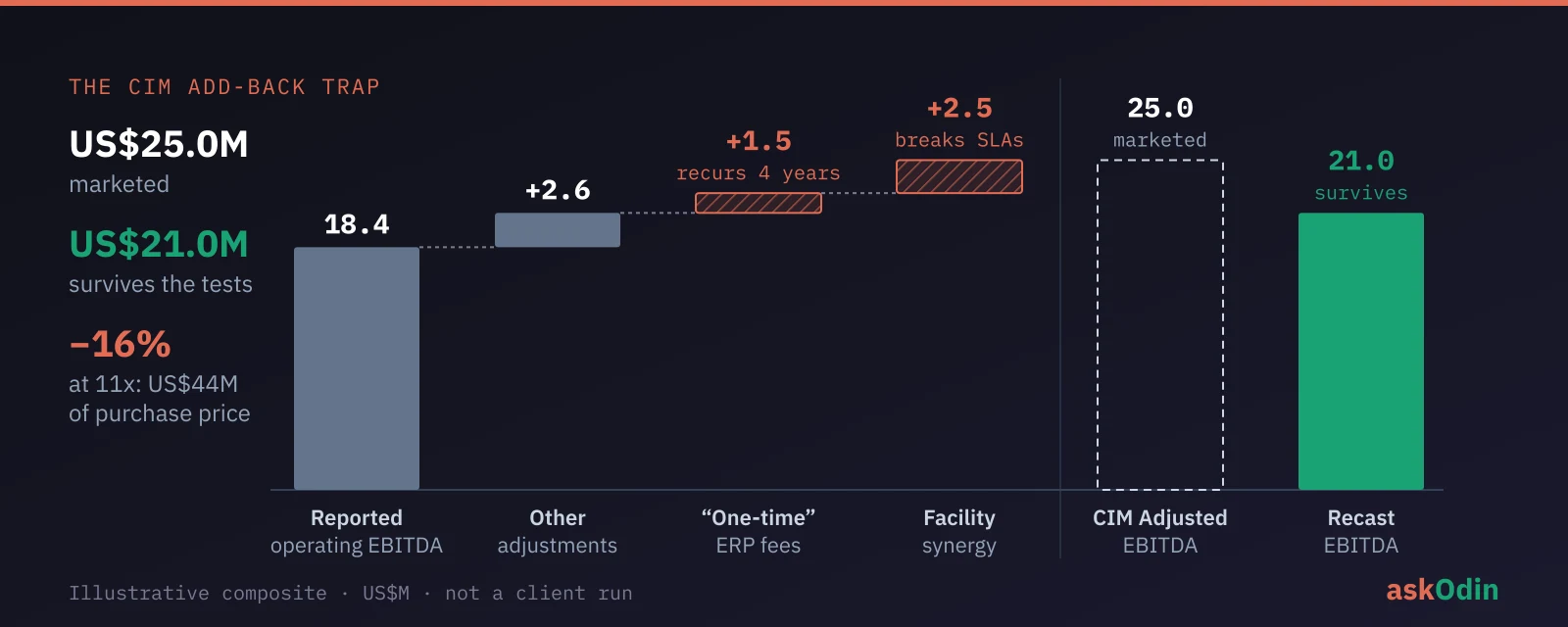
When an investment bank distributes a Confidential Information Memorandum (CIM), the headline numbers are not designed to reflect unvarnished accounting reality. They are engineered to maximize enterprise value. A target generating US$18.4 million in historical operating earnings is routinely marketed as a US$25 million asset through the art of the add-back: pro-forma synergies, normalized owner compensation, and “one-time” restructuring expenses.
As transaction velocity accelerates, a dangerous habit has formed across private equity deal teams: feeding 100-page CIMs and the accompanying financial decks into conversational AI copilots and asking, “Summarize the earnings bridge and flag unusual add-backs.”
What the deal team receives is a masterclass in narrative smoothing.
A language model reads the investment bank’s footnote explaining why a US$1.5 million technology upgrade was “a non-recurring expense,” accepts the prose at face value, and hands that persuasion right back to the associate.
Language models do not cross-examine by design. A conversational prompt does not test that footnote against the multi-year operating schedules in the appendix to see whether the company has incurred “one-time” software costs in every fiscal year since 2022.
On a recent episode of Goldman Sachs’ Exchanges podcast, Chris Churchman, who leads the firm’s Marquee platform, described what happened when his team challenged the model underneath it hard:
“It was like, ‘Look, in the end, I’m better at sounding thorough than being thorough.’”
In middle-market buyout diligence, sounding thorough is an expensive failure mode.
The anatomy of the collision
The structural errors in transaction underwriting rarely hide within a single paragraph. They sit in the whitespace between the narrative claims in the presentation and the cold numbers in the supporting schedules.
Three fault lines recur in middle-market sale processes:
”US$25.0M Adjusted EBITDA (28% margin)"
"Fully normalized, historical cash flow”
Recurring operating expense labeled one-off
Working capital stretched ahead of the auction
1. The perpetual “one-time” add-back
The CIM markets an EBITDA bridge that adds back US$1.5 million for “non-recurring enterprise resource planning (ERP) optimization fees.”
Tested against the multi-year historical expense schedules supplied with it, the numbers show that the business has expensed between US$1.2 million and US$1.5 million under varying consulting and upgrade labels in each of the past four fiscal years.
The expense the CIM calls non-recurring, by fiscal year, in US$ millions. Only FY25 is presented as one-time.
- FY22 · "Systems consulting" 1.2M
- FY23 · "Digital transformation" 1.4M
- FY24 · "ERP upgrade" 1.5M
- FY25 · "ERP optimization" (add-back #3) 1.5M
Source: Illustrative composite figures, not a client run
This is not a non-recurring event. It is the baseline maintenance required to keep the business running. Recasting this single item removes US$1.5 million from recurring EBITDA. At an 11x entry multiple, that one adjustment carries US$16.5 million of purchase price risk. (The arithmetic of add-backs at the multiple is the subject of an earlier piece.)
2. The working capital peg squeeze
In the months leading up to an auction, management can elevate cash conversion by stretching accounts payable (letting Days Payable Outstanding drift from 42 days to 68) while delaying routine inventory reorders.
Days payable outstanding. The 26-day stretch shows up as record cash conversion in the deck.
- 36-month baseline 42 days
- Months before the sale process 68 days
Source: Illustrative composite figures, not a client run
The presentation deck highlights record cash conversion. The balance sheet exhibits show that operating liquidity has been hollowed out.
The working capital peg is a balance sheet adjustment rather than an EBITDA deduction, but its cash impact is immediate. If a deal team accepts the seller’s proposed peg without examining historical DPO and DSO trends, the sponsor absorbs a Day-30 liquidity deficit after close and an unplanned equity injection to fund normalized vendor payments. The peg is the second negotiation, and it is the one that gets less scrutiny.
3. Pro-forma synergy double-counting
The CIM asserts US$2.5 million in “run-rate cost savings” from consolidating two regional fulfillment centers.
Cross-examining the facility lease exhibits against the customer contract disclosures shows that 40% of the target’s regional enterprise revenue is bound to guaranteed same-day delivery service level agreements (SLAs) served from those exact facilities.
Eliminating the facility overhead triggers customer cancellation rights. The projected “synergy” guarantees a top-line decline.
Extensible judgment: the CIM evaluation architecture
To audit high-stakes transactions, software cannot rely on conversational text generation. It needs an extensible verification architecture.
AI Judgment Infrastructure operates as a deterministic verification layer. Rather than treating a data room as a text corpus to be summarized, it extracts the natural language assertions into discrete claims and evaluates them against deterministic constraints. The standard is fixed; domain modules plug into it.
The standard does not change between asset types. Each module brings the extraction rules and tests for its own documents.
The standard
- 5 pillars · 3 audit checks
- JUDGE: Critical · Major · Minor
- Defensible Audit Log
-
Module
Pitch decks and investment memos
- · Claims against the model behind them
- · Structural archetype match
- · Funding and runway physics
-
Module
CIM evaluation
- · Persistence test (add-backs)
- · Working capital trend test
- · Contract-compatibility test
-
Module
Next document type
Same standard, same record, new extraction rules.
Applied to private equity transactions, a CIM evaluation module runs structured tests across the document set:
- The persistence test. The module extracts every narrative add-back and matches its expense signature across the multi-year historical exhibits. If an expense recurs across several vintages under shifting nomenclature, the module denies its non-recurring status.
- The working capital trend test. The module computes DPO, DSO and inventory turnover baselines across 24 to 36 months, identifying balance sheet movement engineered ahead of the auction.
- The contract-compatibility test. The module maps proposed pro-forma cost synergies against the customer agreement exhibits, checking whether the planned operational cuts violate contracted delivery commitments.
Persuasion vs. physics, side by side
Below is an illustrative comparison of how a conversational AI assistant and a deterministic compiler read the same transaction disclosures.
”The target company demonstrates strong 28% Adjusted EBITDA margins with US$6.6M in defensible adjustments, primarily related to non-recurring ERP upgrades and facility rationalization.”
[VERDICT: NARRATIVE SMOOTHING]
[CRITICAL · KILL SHOT · PILLAR 4: BUSINESS MODEL PHYSICS]
Synergy (US$2.5M facility consolidation) conflicts with same-day SLAs covering 40% of regional enterprise revenue. Synergy disallowed.
[MAJOR · PILLAR 5: DEAL STRUCTURE]
Add-back #3 (US$1.5M ERP upgrade) recurs across 4 consecutive fiscal years (FY22: $1.2M, FY23: $1.4M, FY24: $1.5M, FY25: $1.5M). Reclassified as recurring OpEx.
Recast Adjusted EBITDA: US$21.0M (−16.0%)
[MAJOR · PILLAR 5: DEAL STRUCTURE]
Accounts payable stretched 26 days against the 36-month baseline. Estimated post-close cash shortfall against the proposed peg: US$4.1M.
[VERDICT: DO NOT PROCEED]
Two findings remove US$4.0 million from the EBITDA the multiple is applied to. At 11x, that is US$44 million of purchase price. When deal teams use conversational search, they take the left column to the Investment Committee.
Why does conversational AI miss recurring add-backs?
Language models work by predicting the most probable sequence of tokens. They are trained to produce prose that sounds authoritative, fluent, and contextually appropriate.
When an investment bank writes a persuasive footnote justifying why an expenditure was unusual, an LLM evaluates the plausibility of the explanation. It does not evaluate the arithmetic in the schedules.
A deterministic compiler reverses the workflow:
Conversational copilot
- Read CIM and footnotes as one text corpus
- Summarize Weighs how plausible the explanation sounds
- Memo Fluent prose, no trace to the schedules
- Narrative smoothing
Deterministic compiler
- Extract Each add-back becomes a discrete claim
- Evaluate Deterministic tests against the multi-year exhibits
- Record Findings tiered and traceable to their source
- Finding raised
- It decouples extraction from evaluation. Natural language assertions are extracted into discrete variables, then tested against deterministic constraints outside the model.
- It evaluates the whitespace. It does not read disclosures in isolation; it holds the presentation footnote against the multi-year appendix.
- It enforces runtime circuit breakers. When an add-back fails a persistence test, the system raises a finding rather than smoothing over the discrepancy.
LLMs optimize for persuasion. askOdin compiles for physics.
The Monday morning IC checklist: four questions before you sign an exclusivity LOI
Before an Investment Committee signs an exclusivity agreement or commits capital to an external diligence retainer, require the deal team to answer four questions directly from the primary schedules:
Monday morning IC checklist
Four questions before you sign an exclusivity LOI
- 01 How many consecutive fiscal years has each "one-time" add-back appeared in the financial exhibits? If an operating expense category has appeared for more than 24 months under varying labels, it is recurring operating expenditure.
- 02 What is the normalized working capital peg, adjusted for multi-year DPO and DSO trends? Have payables been stretched or receivables accelerated to manufacture cash conversion ahead of the sale process?
- 03 Are the pro-forma cost synergies contractually compatible with existing customer SLAs? Does closing facilities or trimming headcount violate delivery guarantees or performance standards in key customer contracts?
- 04 Does the proposed debt structure survive a 15% haircut to management's Adjusted EBITDA? If the leverage model needs every dollar of management adjustments to avoid covenant default, the capital structure is fragile.
If a deal team cannot answer these from the disclosures, it is not underwriting business fundamentals. It is underwriting an investment bank’s marketing narrative. These questions belong before exclusivity, not after it; that is the case for moving the scrutiny ahead of the quality of earnings.
Deterministic diligence for private capital
When generative models let sell-side advisors manufacture institutional-grade narrative in seconds, unverified persuasion is an unhedged risk.
askOdin provides the deterministic infrastructure to audit reasoning, surface cross-document contradictions, and test business physics before capital is wired. Inspect a live terminal audit in the askOdin Sandbox, or talk to the team about an institutional diligence pilot.
Venture capital is the last unaudited asset class. askOdin provides the infrastructure to close the gap.
YekSoon Lok is the Founder & CEO of askOdin, building the AI Judgment Infrastructure™ for private capital.